Keywords


 4'53", 42Mb

We present a novel hardware device based on ferromagnetic sensing, capable of detecting the presence, position and deformation of any ferrous object placed on or near its surface. These objects can include ball bearings, magnets, iron filings, and soft malleable bladders filled with ferrofluid. Our technology can be used to build reconfigurable input devices -- where the physical form of the input device can be assembled using combinations of such ferrous objects. This allows users to rapidly construct new forms of input device, such as a trackball-style device based on a single large ball bearing, tangible mixers based on a collection of sliders and buttons with ferrous components, and multi-touch malleable surfaces using a ferrofluid bladder. We discuss the implementation of our technology, its strengths and limitations, and potential application scenarios.
 4'15", 47Mb
 We present Bonfire, a self-contained mobile computing system that uses two laptop-mounted laser micro-projectors to project an interactive display space to either side of a laptop keyboard. Coupled with each micro-projector is a camera to enable hand gesture tracking, object recognition, and information transfer within the projected space. Thus, Bonfire is neither a pure laptop system nor a pure tabletop system, but an integration of the two into one new nomadic computing platform. This integration (1) enables observing the periphery and responding appropriately, e.g., to the casual placement of objects within its field of view, (2) enables integration between physical and digital objects via computer vision, (3) provides a horizontal surface in tandem with the usual vertical laptop display, allowing direct pointing and gestures, and (4) enlarges the input/output space to enrich existing applications. We describe Bonfire's architecture, and offer scenarios that highlight Bonfire's advantages. We also include lessons learned and insights for further development and use.
 4'31", 29Mb
 4'20", 50Mb
 6'24", 82Mb

 2'33", 48Mb
  3'41", 27Mb
  5'00", 40Mb
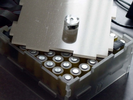
 We present a system for the actuation of tangible magnetic widgets (Madgets) on interactive tabletops. Our system combines electromagnetic actuation with fiber optic tracking to move and operate physical controls. The presented mechanism supports actuating complex tangibles that consist of multiple parts. A grid of optical fibers transmits marker positions past our actuation hardware to cameras below the table. We introduce a visual tracking algorithm that is able to detect objects and touches from the strongly sub-sampled video input of that grid. Six sample Madgets illustrate the capabilities of our approach, ranging from tangential movement and height actuation to inductive power transfer. Madgets combine the benefits of passive, untethered, and translucent tangibles with the ability to actuate them with multiple degrees of freedom.
 6'39", 39Mb