Keywords



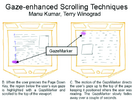

Scrolling is an essential part of our everyday computing experience. Contemporary scrolling techniques rely on the explicit initiation of scrolling by the user. The act of scrolling is tightly coupled with the user?s ability to absorb information via the visual channel. The use of eye gaze information is therefore a natural choice for enhancing scrolling techniques. We present several gaze-enhanced scrolling techniques for manual and automatic scrolling which use gaze information as a primary input or as an augmented input. We also introduce the use off-screen gaze-actuated buttons for document navigation and control.

 3'03", 16Mb
  2'30", 33Mb
  3'41", 27Mb
  4'48", 23Mb
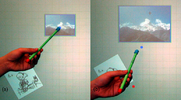
A number of projects within the computer graphics, computer vision, and human-computer interaction communities have recognized the value of using projected structured light patterns for the purposes of doing range finding, location dependent data delivery, projector adaptation, or object discovery and tracking. However, most of the work exploring these concepts has relied on visible structured light patterns resulting in a caustic visual experience. In this work, we present the first design and implementation of a high-resolution, scalable, general purpose invisible near-infrared projector that can be manufactured in a practical manner. This approach is compatible with simultaneous visible light projection and integrates well with future Digital Light Processing (DLP) projector designs -- the most common type of projectors today. By unifying both the visible and non-visible pattern projection into a single device, we can greatly simply the implementation and execution of interactive projection systems. Additionally, we can inherently provide location discovery and tracking capabilities that are unattainable using other approaches.
 3'18", 16Mb