Keywords


 4'48", 40Mb

We present Scratch Input, an acoustic-based input technique that relies on the unique sound produced when a fingernail is dragged over the surface of a textured material, such as wood, fabric, or wall paint. We employ a simple sensor that can be easily coupled with existing surfaces, such as walls and tables, turning them into large, unpowered and ad hoc finger input surfaces. Our sensor is sufficiently small that it could be incorporated into a mobile device, allowing any suitable surface on which it rests to be appropriated as a gestural input surface. Several example applications were developed to demonstrate possible interactions. We conclude with a study that shows users can perform six Scratch Input gestures at about 90% accuracy with less than five minutes of training and on wide variety of surfaces.
 4'53", 42Mb
 We present a novel hardware device based on ferromagnetic sensing, capable of detecting the presence, position and deformation of any ferrous object placed on or near its surface. These objects can include ball bearings, magnets, iron filings, and soft malleable bladders filled with ferrofluid. Our technology can be used to build reconfigurable input devices -- where the physical form of the input device can be assembled using combinations of such ferrous objects. This allows users to rapidly construct new forms of input device, such as a trackball-style device based on a single large ball bearing, tangible mixers based on a collection of sliders and buttons with ferrous components, and multi-touch malleable surfaces using a ferrofluid bladder. We discuss the implementation of our technology, its strengths and limitations, and potential application scenarios.

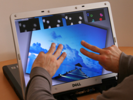
ThinSight is a novel optical sensing system, fully integrated into a thin form factor display, capable of detecting multi-ple fingers placed on or near the display surface. We describe this new hardware in detail, and demonstrate how it can be embedded behind a regular LCD, allowing sensing without degradation of display capability. With our approach, fingertips and hands are clearly identifiable through the display. The approach of optical sensing also opens up the exciting possibility for detecting other physical objects and visual markers through the display, and some initial experiments are described. We also discuss other novel capabilities of our system: interaction at a distance using IR pointing devices, and IR-based communication with other electronic devices through the display. A major advantage of ThinSight over existing camera and projector based optical systems is its compact, thin form-factor making such systems even more deployable. We therefore envisage using ThinSight to capture rich sensor data through the display which can be processed using computer vision techniques to enable both multi-touch and tangible interaction.
 1'25", 15Mb
 Interacting with mobile devices using touch can lead to fingers occluding valuable screen real estate. For the smallest devices, the idea of using a touch-enabled display is almost wholly impractical. In this paper we investigate sensing user touch around small screens like these. We describe a prototype device with infra-red (IR) proximity sensors embedded along each side and capable of detecting the presence and position of fingers in the adjacent regions. When this device is rested on a flat surface, such as a table or desk, the user can carry out single and multi-touch gestures using the space around the device. This gives a larger input space than would otherwise be possible which may be used in conjunction with or instead of on-display touch input. Following a detailed description of our prototype, we discuss some of the interactions it affords.
 2'46", 48Mb
 3'21", 29Mb