Keywords



TapSongs are presented, which enable user authentication on a single "binary" sensor (e.g., button) by matching the rhythm of tap down/up events to a jingle timing model created by the user. We describe our matching algorithm, which employs absolute match criteria and learns from successful logins. We also present a study of 10 subjects showing that after they created their own TapSong models from 12 examples (< 2 minutes), their subsequent login attempts were 83.2% successful. Furthermore, aural and visual eavesdropping of the experimenter's logins resulted in only 10.7% successful imposter logins by subjects. Even when subjects heard the target jingles played by a synthesized piano, they were only 19.4% successful logging in as imposters. These results are attributable to subtle but reliable individual differences in people's tapping, which are supported by prior findings in music psychology.
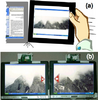
 1'40", 15Mb
 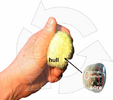 5'25", 30Mb
  4'00", 81Mb
  2'46", 48Mb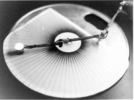
 1'40", 15Mb
  1'24", 10Mb
Numerous methods have been proposed that allow mobile devices to determine where they are located (e.g., home or office) and in some cases, predict what activity the user is currently engaged in (e.g., walking, sitting, or driving). While useful, this sensing currently only tells part of a much richer story. To allow devices to act most appropriately to the situation they are in, it would also be very helpful to know about their placement - for example whether they are sitting on a desk, hidden in a drawer, placed in a pocket, or held in one's hand - as different device behaviors may be called for in each of these situations. In this paper, we describe a simple, small, and inexpensive multispectral optical sensor for identifying materials in proximity to a device. This information can be used in concert with e.g., location information, to estimate, for example, that the device is "sitting on the desk at home", or "in the pocket at work". This paper discusses several potential uses of this technology, as well as results from a two-part study, which indicates that this technique can detect placement at 94.4% accuracy with real-world placement sets.

In this paper, we extrapolate the evolution of mobile devices in one specific direction, namely miniaturization. While we maintain the concept of a device that people are aware of and interact with intentionally, we envision that this concept can become small enough to allow invisible integration into arbitrary surfaces or human skin, and thus truly ubiquitous use. This outcome assumed, we investigate what technology would be most likely to provide the basis for these devices, what abilities such devices can be expected to have, and whether or not devices that size can still allow for meaningful interaction. We survey candidate technologies, drill down on gesture-based interaction, and demonstrate how it can be adapted to the desired form factors. While the resulting devices offer only the bare minimum in feedback and only the most basic interactions, we demonstrate that simple applications remain possible. We complete our exploration with two studies in which we investigate the affordance of these devices more concretely, namely marking and text entry using a gesture alphabet.


In this paper, we present a methodology for recognizing seatedpostures using data from pressure sensors installed on a chair.Information about seated postures could be used to help avoidadverse effects of sitting for long periods of time or to predictseated activities for a human-computer interface. Our system designdisplays accurate near-real-time classification performance on datafrom subjects on which the posture recognition system was nottrained by using a set of carefully designed, subject-invariantsignal features. By using a near-optimal sensor placement strategy,we keep the number of required sensors low thereby reducing costand computational complexity. We evaluated the performance of ourtechnology using a series of empirical methods including (1)cross-validation (classification accuracy of 87% for ten posturesusing data from 31 sensors), and (2) a physical deployment of oursystem (78% classification accuracy using data from 19sensors).