Keywords


 3'31", 19Mb

PhoneTouch is a novel technique for integration of mobile phones and interactive surfaces. The technique enables use of phones to select targets on the surface by direct touch, facilitating for instance pick&drop-style transfer of objects between phone and surface. The technique is based on separate detection of phone touch events by the surface, which determines location of the touch, and by the phone, which contributes device identity. The device-level observations are merged based on correlation in time. We describe a proof-of-concept implementation of the technique, using vision for touch detection on the surface (including discrimination of finger versus phone touch) and acceleration features for detection by the phone.
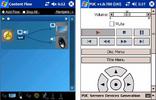
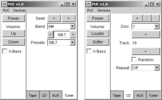
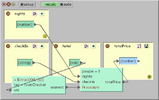

Webmail clients provide millions of end users with convenient and ubiquitous access to electronic mail - the most successful collaboration tool ever. Web email clients are also the platform of choice for recent innovations on electronic mail and for integration of related information services into email. In the enterprise, however, webmail applications have been relegated to being a supplemental tool for mail access from home or while on the road. In this paper, we draw on recent research in the area of electronic mail to understand usage models and performance requirements for enterprise email applications. We then present an innovative architecture for a webmail client. By leveraging recent advances in web browser technology, we show that webmail clients can offer performance and responsiveness that rivals a desktop application while still retaining all the advantages of a browser based client.
 2'27", 13Mb
 Information cannot be found if it is not recorded. Existing rich graphical application approaches interfere with user input in many ways, forcing complex interactions to enter simple information, requiring complex cognition to decide where the data should be stored, and limiting the kind of information that can be entered to what can fit into specific applications' data models. Freeform text entry suffers from none of these limitations but produces data that is hard to retrieve or visualize. We describe the design and implementation of Jourknow, a system that aims to bridge these two modalities, supporting lightweight text entry and weightless context capture that produces enough structure to support rich interactive presentation and retrieval of the arbitrary information entered.
 2'31", 23Mb
In this paper, we present a methodology for recognizing seatedpostures using data from pressure sensors installed on a chair.Information about seated postures could be used to help avoidadverse effects of sitting for long periods of time or to predictseated activities for a human-computer interface. Our system designdisplays accurate near-real-time classification performance on datafrom subjects on which the posture recognition system was nottrained by using a set of carefully designed, subject-invariantsignal features. By using a near-optimal sensor placement strategy,we keep the number of required sensors low thereby reducing costand computational complexity. We evaluated the performance of ourtechnology using a series of empirical methods including (1)cross-validation (classification accuracy of 87% for ten posturesusing data from 31 sensors), and (2) a physical deployment of oursystem (78% classification accuracy using data from 19sensors).