Keywords

 2'12", 40Mb

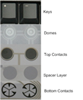
A pressure sensitive computer keyboard is presented that independently senses the force level on every depressed key. The design leverages existing membrane technologies and is suitable for low-cost, high-volume manufacturing. A number of representative applications are discussed.
 1'44", 9Mb
 We demonstrate a pressure-sensitive depth sorting technique that extends standard two-dimensional (2D) manipulation techniques, particularly those used with multi-touch or multi-point controls. We combine this layering operation with a page-folding metaphor for more fluid interaction in applications requiring 2D sorting and layout.
 4'43", 22Mb
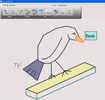
 We present the design of Lineogrammer, a diagram-drawing system motivated by the immediacy and fluidity of pencil-drawing. We attempted for Lineogrammer to feel like a modeless diagramming "medium" in which stylus input is immediately interpreted as a command, text label or a drawing element, and drawing elements snap to or sculpt from existing elements. An inferred dual representation allows geometric diagram elements, no matter how they were entered, to be manipulated at granularities ranging from vertices to lines to shapes. We also integrate lightweight tools, based on rulers and construction lines, for controlling higher-level diagram attributes, such as symmetry and alignment. We include preliminary usability observations to help identify areas of strength and weakness with this approach.

Rotate-Scale-Translate (RST) interactions have become the de facto standard when interacting with two-dimensional (2D) contexts in single-touch and multi-touch environments. Because the use of RST has thus far focused almost entirely on 2D, there are not yet standard techniques for extending these principles into three dimensions. In this paper we describe a screen-space method which fully captures the semantics of the traditional 2D RST multi-touch interaction, but also allows us to extend these same principles into three-dimensional (3D) interaction. Just like RST allows users to directly manipulate 2D contexts with two or more points, our method allows the user to directly manipulate 3D objects with three or more points. We show some novel interactions, which take perspective into account and are thus not available in orthographic environments. Furthermore, we identify key ambiguities and unexpected behaviors that arise when performing direct manipulation in 3D and offer solutions to mitigate the difficulties each presents. Finally, we show how to extend our method to meet application-specific control objectives, as well as show our method working in some example environments.
 4'00", 81Mb
  4'21", 22Mb