Keywords

 3'08", 45Mb
 4'35", 53Mb
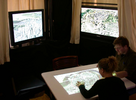
This paper presents a programmable infrared (IR) technique that utilizes invisible, programmable markers to support interaction beyond the surface of a diffused-illumination (DI) multi-touch system. We combine an IR projector and a standard color projector to simultaneously project visible content and invisible markers. Mobile devices outfitted with IR cameras can compute their 3D positions based on the markers perceived. Markers are selectively turned off to support multi-touch and direct on-surface tangible input. The proposed techniques enable a collaborative multi-display multi-touch tabletop system. We also present three interactive tools: i-m-View, i-m-Lamp, and i-m-Flashlight, which consist of a mobile tablet and projectors that users can freely interact with beyond the main display surface. Early user feedback shows that these interactive devices, combined with a large interactive display, allow more intuitive navigation and are reportedly enjoyable to use.
 3'01", 30Mb
  3'14", 38Mb
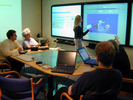
 Multi-display environments compose displays that can be at different locations from and different angles to the user; as a result, it can become very difficult to manage windows, read text, and manipulate objects. We investigate the idea of perspective as a way to solve these problems in multi-display environments. We first identify basic display and control factors that are affected by perspective, such as visibility, fracture, and sharing. We then present the design and implementation of E-conic, a multi-display multi-user environment that uses location data about displays and users to dynamically correct perspective. We carried out a controlled experiment to test the benefits of perspective correction in basic interaction tasks like targeting, steering, aligning, pattern-matching and reading. Our results show that perspective correction significantly and substantially improves user performance in all these tasks.