Keywords



Current interactions on direct-touch interactive surfaces are often modeled based on properties of the input channel that are common in traditional graphical user interfaces (GUI) such as x-y coordinate information. Leveraging additional information available on the surfaces could potentially result in richer and novel interactions. In this paper we specifically explore the role of finger orientation. This property is typically ignored in touch-based interactions partly because of the ambiguity in determining it solely from the contact shape. We present a simple algorithm that unambiguously detects the directed finger orientation vector in real-time from contact information only, by considering the dynamics of the finger landing process. Results of an experimental evaluation show that our algorithm is stable and accurate. We then demonstrate how finger orientation can be leveraged to enable novel interactions and to infer higher-level information such as hand occlusion or user position. We present a set of orientation-aware interaction techniques and widgets for direct-touch surfaces.
Current interactions on direct-touch interactive surfaces are often modeled based on properties of the input channel that are common in traditional graphical user interfaces (GUI) such as x-y coordinate information. Leveraging additional information available on the surfaces could potentially result in richer and novel interactions. In this paper we specifically explore the role of finger orientation. This property is typically ignored in touch-based interactions partly because of the ambiguity in determining it solely from the contact shape. We present a simple algorithm that unambiguously detects the directed finger orientation vector in real-time from contact information only, by considering the dynamics of the finger landing process. Results of an experimental evaluation show that our algorithm is stable and accurate. We then demonstrate how finger orientation can be leveraged to enable novel interactions and to infer higher-level information such as hand occlusion or user position. We present a set of orientation-aware interaction techniques and widgets for direct-touch surfaces.
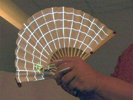
 3'41", 21Mb
 Modern computer displays tend to be in fixed size, rigid, and rectilinear rendering them insensitive to the visual area demands of an application or the desires of the user. Foldable displays offer the ability to reshape and resize the interactive surface at our convenience and even permit us to carry a very large display surface in a small volume. In this paper, we implement four interactive foldable display designs using image projection with low-cost tracking and explore display behaviors using orientation sensitivity.