Keywords

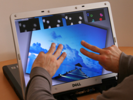


ThinSight is a novel optical sensing system, fully integrated into a thin form factor display, capable of detecting multi-ple fingers placed on or near the display surface. We describe this new hardware in detail, and demonstrate how it can be embedded behind a regular LCD, allowing sensing without degradation of display capability. With our approach, fingertips and hands are clearly identifiable through the display. The approach of optical sensing also opens up the exciting possibility for detecting other physical objects and visual markers through the display, and some initial experiments are described. We also discuss other novel capabilities of our system: interaction at a distance using IR pointing devices, and IR-based communication with other electronic devices through the display. A major advantage of ThinSight over existing camera and projector based optical systems is its compact, thin form-factor making such systems even more deployable. We therefore envisage using ThinSight to capture rich sensor data through the display which can be processed using computer vision techniques to enable both multi-touch and tangible interaction.

 1'25", 15Mb
 Interacting with mobile devices using touch can lead to fingers occluding valuable screen real estate. For the smallest devices, the idea of using a touch-enabled display is almost wholly impractical. In this paper we investigate sensing user touch around small screens like these. We describe a prototype device with infra-red (IR) proximity sensors embedded along each side and capable of detecting the presence and position of fingers in the adjacent regions. When this device is rested on a flat surface, such as a table or desk, the user can carry out single and multi-touch gestures using the space around the device. This gives a larger input space than would otherwise be possible which may be used in conjunction with or instead of on-display touch input. Following a detailed description of our prototype, we discuss some of the interactions it affords.
 5'02", 33Mb
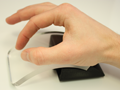
 In this paper we present novel input devices that combine the standard capabilities of a computer mouse with multi-touch sensing. Our goal is to enrich traditional pointer-based desktop interactions with touch and gestures. To chart the design space, we present five different multi-touch mouse implementations. Each explores a different touch sensing strategy, which leads to differing form-factors and hence interactive possibilities. In addition to the detailed description of hardware and software implementations of our prototypes, we discuss the relative strengths, limitations and affordances of these novel input devices as informed by the results of a preliminary user study.