Keywords

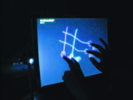
 1'02", 5Mb
 2'25", 34Mb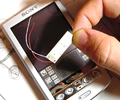

 5'35", 31Mb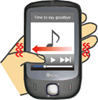

One of the challenges with using mobile touch-screen devices is that they do not provide tactile feedback to the user. Thus, the user is required to look at the screen to interact with these devices. In this paper, we present SemFeel, a tactile feedback system which informs the user about the presence of an object where she touches on the screen and can offer additional semantic information about that item. Through multiple vibration motors that we attached to the backside of a mobile touch-screen device, SemFeel can generate different patterns of vibration, such as ones that flow from right to left or from top to bottom, to help the user interact with a mobile device. Through two user studies, we show that users can distinguish ten different patterns, including linear patterns and a circular pattern, at approximately 90% accuracy, and that SemFeel supports accurate eyes-free interactions.
 2'45", 24Mb
 We present a new technology for enhancing touch interfaces with tactile feedback. The proposed technology is based on the electrovibration principle, does not use any moving parts and provides a wide range of tactile feedback sensations to fingers moving across a touch surface. When combined with an interactive display and touch input, it enables the design of a wide variety of interfaces that allow the user to feel virtual elements through touch. We present the principles of operation and an implementation of the technology. We also report the results of three controlled psychophysical experiments and a subjective user evaluation that describe and characterize users' perception of this technology. We conclude with an exploration of the design space of tactile touch screens using two comparable setups, one based on electrovibration and another on mechanical vibrotactile actuation.