UIST 2026 Papers: From Submission to Final Decisions
Final paper decisions are out. 1,316 external reviewers and 158 committee members wrote 3,271 reviews and 1,120 meta reviews. The rebuttal changed scores for most papers above 2.5, and the PC meetings changed AC recommendations for 15.2% of papers.
We have now distributed final paper decisions to authors who submitted their papers to UIST 2026. This post summarizes what happened to those papers during the review process and answers a frequently asked question: how much do the different stages of the review process matter?
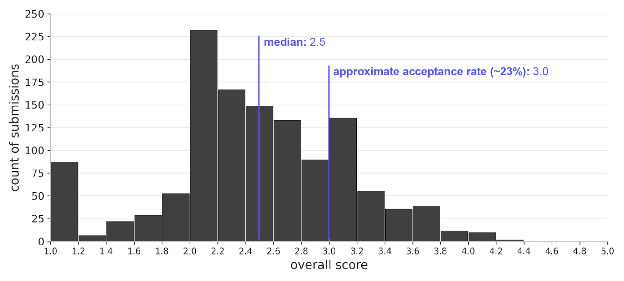
First, to summarize from our last post, the UIST 2026 papers track received 1,259 complete submissions. This was a record high, a 33% increase from UIST 2025. 1,175 of these papers moved past the desk rejection stage to our full review process. Papers that made it to this stage received 4 reviews: two from committee members (ACs) and two from external reviewers. Each reviewer assigned the paper a score from 1.0 (lowest) to 5.0 (highest). The mean of these scores is called the "Overall Score".
The work behind the reviews
Moving 1,175 papers through our full review process represents an extraordinary amount of work by the UIST community. The rest of this post includes data only from papers that received a full external review, and it represents a subset of those papers, with a small number excluded due to the Paper Chair’s conflicts when downloading paper data.
1,316 external reviewers and 158 committee members contributed a total of 3,271 full reviews, and those committee members contributed 1,120 meta reviews.
This work is unevenly distributed: most external reviewers contributed only one review, and fewer than 10% contributed four or more. UIST committee members often strive to match expertise to the paper such that one reviewer may have expertise that is tailor-fit to a particular paper. Moving forward, there may still be an opportunity to distribute the reviewing load a bit more among qualified reviewers.

Together, the program committee members and external reviewers contributed a total of 2.62 million words across all of these reviews, and 2.93 million words if we include all fields such as post-rebuttal and post-PC meeting updates. Over half of these words were contributed by external reviewers who wrote substantial reviews that ranged from 143 words for the shortest review to 4,566 words for the longest review.

Beyond the reviews themselves, reviewers and committee members contributed a total of 5,197 discussion comments throughout the entire process. 2,381 (or 45.8%) of discussion comments were added after the rebuttal. In total, papers received a mean of 4.80 (SD = 3.35) discussion comments, but papers along the decision boundary in initial reviews (2.5–3.5) received the highest number of comments, with a mean of 6.18 (SD = 3.41) comments. Finally, a subset of papers were discussed at one of three program committee (PC) meetings.
So, do the rebuttal and PC meeting actually matter?
In short, yes. The rebuttal shifted paper scores, and the PC determined paper recommendations.
First, we wanted to take a look at how scores changed across three snapshots: before rebuttal, after rebuttal but before the PC meeting, and after the PC meeting. This initial analysis would suggest that the overall scores barely change throughout our process. In fact, the mean score stays between 2.55 and 2.58 and the median score stays at 2.5 across all three snapshots.

However, when we plot changes for individual papers, at a glance, many papers had scores that changed substantially between the initial snapshot (before rebuttal) and the final snapshot (after the PC meeting). Changes appear to be concentrated in papers with scores above 2.5.

Thus, we also examined score changes based on the overall scores before rebuttal. It turned out that scores changed for the majority of papers with pre-rebuttal scores higher than 2.51.
| Before rebuttal | Score changed | Score increased | Score decreased | Accepted |
|---|---|---|---|---|
| ≤ 2.00 | 4.3% | 2.1% | 2.1% | 0% |
| 2.01–2.50 | 21.3% | 9.4% | 11.9% | 1.8% |
| 2.51–3.00 | 64.1% | 26.5% | 37.6% | 19.5% |
| 3.01–3.50 | 71.2% | 54.6% | 16.6% | 77.9% |
| > 3.50 | 54% | 50.8% | 3.2% | 98.4% |
| All | 36.9% | 20.5% | 16.4% | 21.4% |
The majority of these changes occurred between the rebuttal and the PC meeting (33.9%) rather than during the PC meeting itself (6.4%, with a slight overlap between both stages). A reason for this is that, primarily, contested papers are nominated for discussion at the PC meeting stage, where deliberations happen directly among committee members rather than with external reviewers. Because of this, changes during the meeting naturally manifested in AC recommendations rather than numerical scores. In fact, 15.2% of all papers had either a 1AC or 2AC recommendation changed during the PC meeting, most often resolving "Discuss" into a decisive "Accept" or "Reject", showing that the meeting played a meaningful role in shaping final decisions.
It is hard to capture exactly what happened during the PC meeting, as decisions not only happened during synchronous discussions with the committee, but also through 1:1 discussions between 1AC and 2AC at break times. In the US PC meeting, about 81 papers (about 15% of papers allocated in the US split) were discussed at the PC meeting for at least a minute. These papers were discussed for a median time of 7.6 minutes (IQR 4.5–13.3 min). Shorter discussions occasionally involved identifying another committee member with expertise to add as "3AC", or describing a decision on a paper with split reviews. Longer discussions often involved papers right at the decision boundary where committee members weighed the strengths and weaknesses of the paper given standards and tastes of the UIST community. This pattern was similar across the other splits (Seoul and Copenhagen). As a result, PC meetings serve to not only make decisions on specific papers but also educate committee members on the values of our community through these discussions.
Thank you again to the authors for their submissions, and to our entire community for these reviewing efforts. An increasingly distinguishing asset of UIST is our high-quality peer review process, and we are grateful for the community that makes this possible.