Keywords

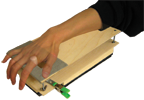


Tactile feedback allows devices to communicate with users when visual and auditory feedback are inappropriate. Unfortunately, current vibrotactile feedback is abstract and not related to the content of the message. This often clash-es with the nature of the message, for example, when sending a comforting message.
We propose addressing this by extending the repertoire of haptic notifications. By moving an actuator perpendicular to the user's skin, our prototype device can tap the user. Moving the actuator parallel to the user's skin induces rub-bing. Unlike traditional vibrotactile feedback, tapping and rubbing convey a distinct emotional message, similar to those induced by human-human touch.
To enable these techniques we built a device we call soundTouch. It translates audio wave files into lateral motion using a voice coil motor found in computer hard drives. SoundTouch can produce motion from below 1Hz to above 10kHz with high precision and fidelity.
We present the results of two exploratory studies. We found that participants were able to distinguish a range of taps and rubs. Our findings also indicate that tapping and rubbing are perceived as being similar to touch interactions exchanged by humans.
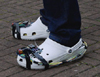
In this paper we describe Gilded Gait, a system that changes the perceived physical texture of the ground, as felt through the soles of users' feet. Ground texture, in spite of its potential as an effective channel of peripheral information display, has so far been paid little attention in HCI research. The system is designed as a pair of insoles with embedded actuators, and utilizes vibrotactile feedback to simulate the perceptions of a range of different ground textures. The discreet, low-key nature of the interface makes it particularly suited for outdoor use, and its capacity to alter how people experience the built environment may open new possibilities in urban design.