


Important Notice
Sheridan, UIST's publisher, is requiring changes to all templates for Paper, Demo, Poster, and Doctoral Symposium in order to process final submissions. They are:
- Use the 2012 ACM classifiers, not the 1998 one: https://dl.acm.org/ccs/ccs.cfm
- Remove all headers and page numbers
- Use square brackets in the references list at the end of the paper, not a dotted list: [1], not 1.
For authors who use LaTeX, Sheridan requests that they use the template here: https://chi2020.acm.org/authors/chi-proceedings-format.
If the authors use Microsoft Word, they can manually make the changes above or use the new MSWord template here: https://chi2020.acm.org/authors/chi-proceedings-format/
Appropriate Topics
Appropriate topics include, but are not limited to:- Enabling software and/or hardware technologies that open novel opportunities for interaction.
- Designs that demonstrate compelling new interactive experiences.
- Methods, architectures, and infrastructures for interactive systems.
In recent years, successful UIST submissions have focused on domains including: input and output devices, augmented/virtual reality, programming tools, mobile interaction, haptic and tactile interfaces, human-robot interaction, AI and HCI, fabrication, design and prototyping tools, creativity tools, ubiquitous computing, accessibility, visualization, information management, wearable computing, social computing, toolkits, education, crowdsourcing, and computer-supported cooperative work. We look forward to relevant submissions in novel domains as well.
Authors of all accepted papers will also be invited and encouraged to participate in the demo session. All papers should be submitted electronically to: http://new.precisionconference.com/~sigchi. To create a new submission in PCS 2.0, first click “Submissions” at the top of the page. You will be presented with 3 dropdown menus for the submission society, conference, and track. Select “SIGCHI”, “UIST 2019” and “UIST 2019 Papers” respectively, and hit "Go".
Important Dates
-
Paper deadlineApril 5, 2019, 5pm PDTPosters deadlineJuly 10, 2019, 5pm PDTDemos deadlineJuly 10, 2019, 5pm PDTDoctoral symposium deadlineJuly 10, 2019 12pm PDTStudent volunteers deadlineJuly 12, 2019UIST visions deadlineJuly 12, 2019, 5pm PDTStudent innovation contest deadlineAugust 2, 2019 (Extended)
Papers
-
Submission deadlineApril 5, 2019, 5pm PDT -
Reviews sent to authorsMay 31, 2019 -
Rebuttals dueJune 7, 2019, 5pm PDT -
Conditional acceptance notificationJune 21, 2019 -
Final reviews sent to authorsJune 26, 2019 -
Camera-ready versions dueJuly 15, 2019 -
Final acceptance decisionJuly 22, 2019 -
Video preview dueJuly 29, 2019
Papers are the main medium for conveying new research results at UIST. Submissions are sought that describe original, unpublished work on user interface interaction techniques, systems, tools, services, devices or applications. Please consult the UIST 2019 Author's Guide for information on submission format and policies for previous and simultaneous publications. Note that paper submissions must be anonymous! Authors must remove their names and affiliations from the masterhead and refer to their own previous work in third person when possible. See the anonymization policy in the Author’s Guide for more information.
Paper Length and Presentation Time
Papers can be of any page length, though should be commensurate with the size of the contribution. A typical UIST contribution is ten pages plus references. A new idea presented in a compact format is more likely to be accepted than the same idea in a long format. Long papers need to include very strong contributions to warrant acceptance. Shorter, focused papers are an appropriate submission length for UIST and encouraged. References do not count towards the page length. In rare cases, authors may be requested to shorten papers as a result of the review process, for example by removing sections that detracts from a paper’s main contribution. All papers will have the same presentation time at the conference and there will be no distinction made between papers based on length in the program, proceedings or digital library. Exact talk duration will be determined when the program is finalized.
Supporting Video Figure
With the paper submission, authors are also strongly encouraged to submit a supporting video for upto three minutes. This video could help reviewers better understand the look and feel of your research. To prepare your video figure, please see the video guide page.
Submission Requirements
When you submit your work, you will be asked to agree to the terms and conditions of the SIGCHI Submitter Agreement. Late author changes require approval from Program Chairs and may be declined or require paper withdrawal because of reviewing conflicts.
Reviewing and Rebuttal Process
Rigorous reviewing is a hallmark of UIST. Each paper will be reviewed by 3 external reviewers (experts in the area who are not on the Program Committee). Additionally, every paper will receive a review from a member of the Program Committee. On May 31st, 2019, authors will be notified of their initial reviews. If reviews fall below a threshold, the paper will be rejected at this stage; otherwise, the authors will have the opportunity to submit a rebuttal due on June 7, 2019. On June 21, 2019, authors will be notified if their papers have been conditionally accepted or rejected.
Conditional Acceptance
All acceptances will be conditional pending changes that the Program Committee may suggest or require for the final camera-ready paper. This means that a paper will not be accepted to UIST until authors revise and submit the final camera-ready paper for approval by the Program Committee. Any lengthening of the paper for the camera-ready version must be approved by the primary program committee member in charge of the paper (1AC).
Video Previews (After Acceptance)
Video previews (only required for accepted papers) are 30-second clips that describe and showcase a publication before, during, and after the conference. They often attract substantial media attention. Video previews are mandatory accompanying material for Papers, and optional for Posters and Demos. See the video previews page for details. Video previews will be released no sooner than two weeks before the start of the conference. The deadline for video previews is July 29, 2019.
Format
All paper submissions must be made in the SIGCHI papers format. This is the same format that UIST has used in past years, not the more recent experiment from CHI 2019. Note that this format utilizes the newer “Firstname M. Lastname” convention.
Accessibility
Authors are requested to make the pdf of their papers accessible at submission time and will be required to make their pdf accessible after acceptance. In addition, this year we will require camera-ready submissions to include alternative text (alt-text) for all figures in a form field in Percision Conference. This will help UIST committee members to verify and correct inaccessible submissions. We highly recomend that authors draft their alt-text before submitting their paper. It may take you about an hour to make your file accessible, so be sure to leave time before the submission deadline to do so. Please refer to the instructions on Creating an Accessible ACM Conference Paper for information on how to accomplish this. For authors writing about disability/ accessibility issues, the ASSETS writing guide may also be helpful.
A note for authors who use LaTex: PDFs created with LaTex are very difficult to make accessible, unless you edit the output directly in Adobe Acrobat. Note that making an accessible PDF is not well-supported by any standard LaTex editors that we are aware of. If you use LaTex, you will need to manually edit your PDF using Adobe Acrobat to make it accessible.
Public Dissemination Date
The title and abstract of all accepted papers are typically announced shortly after the final camera-ready paper deadline on July 29, 2019. Note, however, that this is not the official publication date.
AUTHORS TAKE NOTE: The official publication date is the date the proceedings are made available in the ACM Digital Library. This date may be up to two weeks prior to the first day of your conference. The official publication date affects the deadline for any patent filings related to published work. (For those rare conferences whose proceedings are published in the ACM Digital Library after the conference is over, the official publication date remains the first day of the conference.)
Support for Student Presentations: The SIGCHI Student Travel Grant (SSTG) program is intended to enable students who lack other funding opportunities to attend SIGCHI-sponsored or co-sponsored conferences. This travel grant is intended to support students whose intention is to present at a SIGCHI-sponsored conference, not just attend. More details are available.
Program Committee Chairs
Questions? Contact: program2019@uist.org
 Michael BernsteinStanford University
  Katharina Reinecke
 University of Washington
Posters
-
Submission deadlineJuly 10, 2019, 5pm PDT -
Acceptance notificationAugust 2, 2019 -
Camera-ready versions due
August 9, 2019 -
Video preview due (optional)
August 23, 2019
Posters provide an interactive forum in which authors can present their work to conference attendees during special poster sessions. Posters are an opportunity to describe new work or work that is still in progress, and will be more lightly reviewed than papers. The posters track welcomes innovative research, as well as innovative ways of doing research.
All poster submissions must include a two-page "abstract" and a full size poster design. Note that poster submissions, unlike paper submissions, are not anonymous. The abstract describes the research problem, contribution, and value to UIST attendees. The abstract must be formatted using the SIGCHI Papers Format (use the Word Proceedings Template or Latex Proceedings Template) and submitted as a PDF. The poster design must be less than 30 X 40 inches (76 X 101 cm), either portrait or landscape orientation, and submitted as a PDF. The UIST Poster Example Gallery has ideas and guidelines for poster designs. Authors are also encouraged to submit an optional video no more than three minutes long, see the video guide for acceptable formats.
The poster abstract, poster design, and optional video must be submitted electronically to the new Precision Conference System before the submission date below. The total size for all files must be less than 50 MB. See the video guide, the author guide, and general submission information for more details about preparing your submission.
References do not count towards the page length.
Selection Process
The selection process for UIST posters is juried. As stated in the CHI selection process: "Juried content is reviewed by a committee but in a less rigorous process than refereed and does not include an author’s response or conditional acceptance. Juried content is generally not required to make the same level of lasting and significant contribution to our knowledge and understanding as refereed content. Authors who submit to juried tracks may expect to receive light feedback of up to a few paragraphs in length."
Incomplete or incorrect submission content or formats will be desk rejected. Late submissions are not permitted, and the deadline below is final. Do not submit the same work to both the demo and poster tracks. Double submissions will only be considered as a demo submission and will be automatically rejected from the poster track.
Posters are Non-Archival
UIST posters are non-archival and UIST allows resubmission of posters previously shown at other venues. Authors should state previous poster venues in the appropriate box in the upload form and point out differences to previous posters.
At the Conference
All accepted posters will be displayed during a portion of the conference. At least one author is requested to stand by their poster during poster sessions to speak with conference attendees.
After the Conference
Accepted poster abstracts will be published as adjunct proceedings in the ACM Digital Library and distributed in digital form to conference attendees. Authors can make accepted poster designs and videos available at their discretion.
Poster Chairs
Questions? Contact: posters@uist.org
 Huaishu PengUniversity of Maryland
 Amy X. Zhang
MIT
Demos
-
Submission deadlineJuly 10, 2019, 5pm PDT -
Acceptance notificationAugust 2, 2019 -
Camera-ready versions due
August 9, 2019 -
Video preview due (required)August 23, 2019
Demonstrations show early implementations of novel and compelling interaction concepts, techniques, devices and systems. They can also serve to showcase commercial products not previously described in the research literature. Demonstrations should be brief, and robust enough to be shown repeatedly. We particularly encourage highly interactive demos with strong participant engagement— from novel web systems and prototype devices, to new materials, physical outputs, and large interactive installations. Demos are one of the highlights of the UIST conference, showcased at a special evening reception.
Accepted demonstration abstracts will be published together with posters and doctoral symposium abstracts, and are made available digitally to conference attendees. We also extend invitations to authors of accepted UIST papers to present their work at the demo reception.
A demo submission should follow the SIGCHI proceedings format (not extended abstracts, use the Word Template or Latex Template), and should be no more than two pages in length, not including references. Note that demo submissions, unlike paper submissions, are not anonymous.
All papers should be submitted electronically to: New Precision Conference. References do not count towards the page length.
Accepted UIST Papers
Authors of accepted UIST papers who wish to present demos have two choices:- Authors can do a full demo submission including the two page write up. The abstract will be published together with posters and doctoral symposium abstracts and made available digitally to conference attendees.
- Authors can decide to only submit the (mock-up) photo of the demonstration as described above (fully envisioned setup and labeled). As a result, no extended abstract will be included in the proceedings.
Selection Process
The selection process for UIST demos is curated, that is, selected by an esteemed committee, but not sent out to external reviewers. The curated demo content will be selected from demonstration submissions, accepted papers, as well as projects invited by the demo chairs. Authors will not receive formal feedback on their submission other than the selection decision.
Submission Details
The demo submission should include a (mock-up) photo of the demonstration showing the envisioned setup (demo hardware components, tables, chairs, lights and other equipment), as well as the demonstrators alongside conference attendees interacting with the demo. Please label and annotate all parts of the image(s) so that organizers get a good understanding of your setup. This will also allow the organizers to better consider your requirements when organizing the demonstration space at the conference. Submitting an accompanying video is optional, but highly encouraged. Any submitted video should be no longer than three minutes and at most 50MB in size.
Demos are Non-Archival
UIST demos are non-archival and UIST allows resubmission of demos previously shown at other venues. Authors should state previous demo venues in the appropriate box in the upload form and point out differences to previous demos. See the video guide and the general submission information for more details about preparing your submission. Both the demo abstract and the optional digital video should be submitted electronically to Precision Conference.
Video Previews (After Acceptance)
Video previews (only required for accepted papers) are 30-second clips that describe and showcase a publication before, during, and after the conference. Video previews are mandatory accompanying material for Papers, and optional for Posters and Demos. See the video previews page for details. Video previews are 30-second clips that describe and showcase a publication before, during, and after the conference. They often attract substantial media attention. Video previews will be released no sooner than two weeks before the start of the conference. The deadline for video previews is August 23, 2019.


Doctoral Symposium
-
Submission deadlineJuly 10, 2019 12:00 PDT -
Acceptance notificationAugust 2, 2019 -
Camera-ready versions due
August 9, 2019 -
Welcome dinner
October 19, 2019
-
Doctoral symposium date
October 20, 2019 9am-6pm
The UIST Doctoral Symposium is a forum in which Ph.D. students can meet and discuss their work with each other and a panel of experienced UIST researchers in an informal and interactive setting. We welcome applications from current Ph.D. students studying within the full range of disciplines and approaches that contribute to the UIST community. We will give preference to applicants beyond the proposal stage and well into their dissertation research.
Each applicant should provide a short written paper (no more than four pages (including references) in the official SIGCHI conference publication format (use the Word Template or Latex Template), as described in the author's guide). Note that doctoral symposium submission, unlike paper submission, is not anonymous; doctoral symposium submissions should be single-authored, where the student applying is the sole author. This paper should describe ongoing work and might summarize your full dissertation work, or highlight a particular part in depth.
The Doctoral Symposium committee will select approximately eight students to participate. Participants will be selected based on their anticipated contributions to the breadth and depth of the intellectual discussions of the symposium.
Each student will be expected to give a short presentation of their work, which will be followed by extensive discussion with the panel and the other student participants. The symposium will be held at the UIST conference venue from 9 a.m. until 6 p.m. on Sunday, October 20th, 2019 (and will begin with a welcome dinner the evening of Saturday, October 19th, at 6:30 pm). In addition, each student is encouraged to present a poster describing his or her work to the full conference; posters will be on display for two days during the conference.
Doctoral Symposium abstracts will be published together with poster and demonstration abstracts and made available digitally to conference attendees (though they are considered a “non-archival” publication). Posters may also be published at the participant's discretion.
Accepted students will receive complimentary registration to the UIST 2019 conference, and a complimentary hotel room at the conference venue (on a shared basis; same-gendered members of the symposium will be paired together for room sharing). Travel subsidies will also be available to participants (the exact value of the travel subsidies has not yet been determined).
Doctoral Symposium papers should be submitted electronically to the new Precision Conference System.
The faculty panelists will be:
- Fanny Chevalier, University of Toronto (co-chair)
- Elena Glassman, Harvard (co-chair)
- Scott Klemmer, UC San Diego
- Shumin Zhai, Google
Doctoral Symposium Chairs
Questions? Contact: doctoralsymposium@uist.org
 Fanny ChevalierUniversity of Toronto
 Elena Leah Glassman
 Harvard
Student Volunteers
-
Application dueJuly 12, 2019 -
NotificationAugust 1, 2019
Application Instructions
To apply to be a student volunteer, please sign up at the UIST SV portal.
Benefits and Duties
If you are a UIST Student Volunteer, you get:
- Free conference registration
- Free T-shirt
- A great SV party with free dinner
- A chance to attend the premier forum for innovations in human-computer interfaces
Student volunteers will be required to help set up and perform needed work during the conference. Duties include: bag stuffing, registration desk, AV assistance, poster and demo setup, badge checking, break monitoring, etc. Volunteers will also need to be available during the conference if tasks come up. SVs usually get to attend most of the sessions, even when working. There will be approximately 14 scheduled hours per SV.
Arriving and Leaving
SVs need to be available to help throughout the conference. You will need to arrive on or before Saturday afternoon (Oct. 19) for the SV orientation and should not leave the conference venue until sessions end on Wednesday (Oct. 23). Also, we strongly encourage you to put off leaving until as late as you possibly can, because it's traditional to have a small party for student volunteers on Wednesday evening. The time and place for this party will be announced when we know all the student volunteers' travel plans.
Work Schedules
To give you an idea of what to expect, you can see the UIST 2006 Student Volunteer Schedule.
Accommodation
We will not be able to provide free accommodation, but we will help you team up with other student volunteers for sharing rooms and we will provide a list of hotels with affordable room rates.


UIST Visions
-
Submission deadlineAugust 30, 2019, 5pm PDT -
Reviews sent to authors
September 20, 2019 -
Slide submission
October 11, 2019
Back for its second year, UIST Visions is a venue for forward thinking ideas to inspire the community. The goal is not to report research but to project and propose new research directions. We want to project the UIST community as thought leaders in HCI Technology. Appropriate issues might be:
- Future Trends
- Foundational technologies that we need to make progress
- Significant compelling problems that the community might address
- Something that is missing
- An alternative perspective on what we do
Submission
1 Page, 1 Author, URL for author vita. Submitters must have published at least 5 papers at a SIGCHI venue. We are looking for research leaders with forward-thinking ideas. All submissions should be done electronically to: http://new.precisionconference.com/~sigchi
Review Process
A maximum of 3 speakers can be invited. Review will be based on how interesting and provocative the ideas are in the 1 page proposal. Accepted speakers will be required to sign the approval form to record and publish the talk. We want these talks to be widely shared.
Slide Submission
Slides will be reviewed ahead of the conference to ensure a great, engaging presentation.
Presentation - at the conference
15 minute presentation. No podium, lapel mic and slide button. 15 minute Q&A

Student Innovation Contest
-
Submission deadlineDeadline extended to August 2, 2019 -
Acceptance notification
August 9, 2019
In the UIST Student Innovation Contest (aka the "SIC"), we explore how novel input, interaction, actuation, and output technologies can augment interactive experiences! This year, in partnership with Google, we are seeking students who will push the boundaries of input and output techniques. This year’s theme is Interactive Systems for Social Impact: See, Feel, Hear the Invisible. Join the UIST SIC and turn your ideas into reality! Meet amazing people! Win fabulous prizes!
Deadline to apply is the 2nd of August!
Apply here: http://bit.ly/uist2019sic-reg

The UIST SIC is your opportunity to shine and impress the world with your creative ideas! Participants will demo their work during the demo reception at the conference in New Orleans, Louisiana, USA, and contest winners will be announced during the conference. A jury composed of senior UIST community members will select one team to receive the SIC jury award. On top of that, conference attendees will get a chance to vote for their favorite teams in the People's Choice category. All categories receive prizes!
We will give away the hardware to all selected teams! You can bring it home with you! This is made possible through our generous sponsors!
Hardware Platform
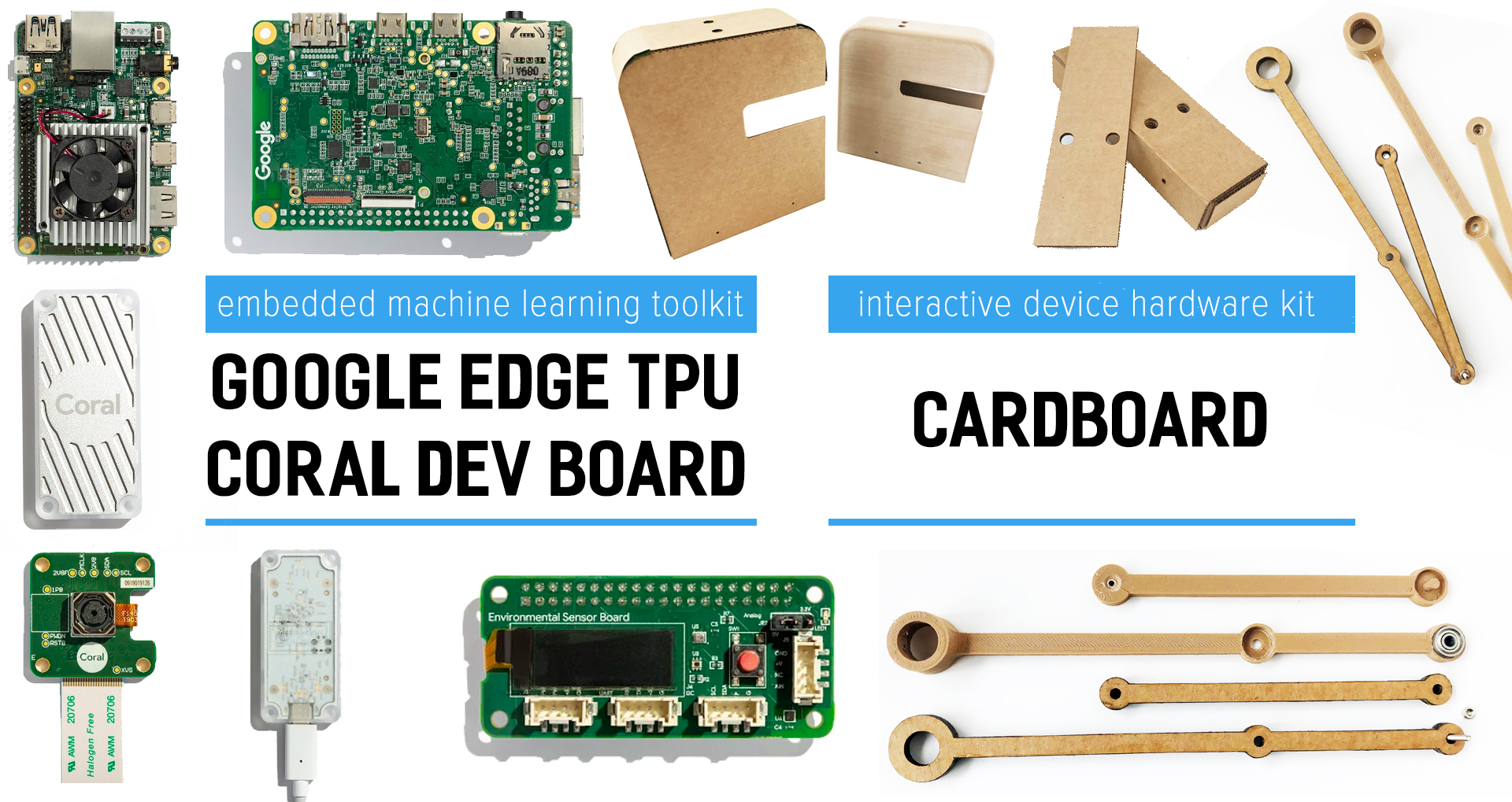
This year’s hardware consists of two parts: an embedded machine learning toolkit sponsored by Google's Bio Interfaces team and Google's Coral team, and a hardware kit containing a number of sensors and actuators that allows you to build interactive devices from cardboard.
For machine learning and inference, selected teams will receive a Google Edge TPU Coral Dev Board. This small computer can run existing machine learning models using Tensorflow Lite, enabling a variety of usages such as image classification. Besides the Dev Board, you will also get a USB accelerator to test and run models from your computer, as well as a camera module. But that’s not all, we want you to consider all kinds of input data, not just images. Therefore, our generous sponsors also included the Environmental Sensor Board into the mix, which provides temperature, atmospheric pressure, ambient light, and humidity sensing. This gives you access to a rich set of data for your project.
The UIST SIC is known for its innovative interactions, and devices with great output capabilities. This year, in an effort to make the event more sustainable and accessible, the tangible component of the contest will have to be fabricated from cardboard. This material was selected since it can be recycled, sourced practically anywhere on the planet and can be used without the need for special tools. To bring your creation to life, you will receive a kit of sensors and actuators containing a 9DOF IMU, a 12-channel capacitive touch sensing module, two infrared distance sensors, 5 vibration motors, 5 servo motors, a solenoid a small speaker and even a small projector, if you can justify its use in your proposal. Combining this hardware with the embedded machine learning toolkit, you can build all kinds of high-tech interactive technologies from low-fidelity, recyclable and easily sourced materials.
UIST 2019 SIC Challenge: Interactive System for Social Impact - See, Feel, hear the Invisible
Motivation
A wide variety of data sources exists around us, ranging from information about air quality and weather in cities, brightness in a room, all the way to physiological signals of users and their 3D pose in a room. Much of this data, however, is not easily accessible and is often invisible to users. The combination of machine learning and interactive systems can be used to make this data available to users, and allows them to interact with their environment in meaningful ways. The goal of the contest is to create output-centric interactive systems that combine advanced machine learning solutions and tangible interfaces created using cardboard, a recyclable and accessible material, to make our world a better place. For example, this can mean creating a system that improves the accessibility of a computer system, a robot that shields the users from pollution, or a system that assists a visually impared user in daily tasks.

Challenge: Design for Social Impact - See, feel, hear the Invisible
Your goal is to implement an interactive system that positively impacts users, their community or the environment. The system should make use of data gathered from sensors (e.g., camera, environmental sensors, IMU, touch sensor, etc.), process the data to make sense of it, and interact with users using cardboard-based mechanisms and interfaces. To successfully address this challenge, you need to figure out 1) what task(s) you want your system to support, and 2) what data you want to use and 3) what interaction you want your system to enable. Your system should motivate the use case and articulate a clear set of assumptions on how it will be beneficial for users, their community and / or the environment. Your system should make use of the data it can gather and enable users to interact with it. Finally, your system does not have to be limited to one user— ideas that involve well executed, multi-user, simultaneous interactions are often crowd favourites at UIST!

Application Areas and Design Space
YYou can build and design your system in a multitude of configurations, which affords the exploration of numerous design primitives. The main constraints are that you make use of sensor data, perform inference on it to make it more accessible or actionable, and provide a way for users to meaningfully interact with the system. Your interactive system should also mainly be built from cardboard. With these constraints in mind, you can tackle one or more application areas, such as:
- Citizen Science
- Make invisible data graspable (e.g., air quality, traffic patterns)
- Medical diagnostics (e.g., use camera data to infer fatigue and act on it)
- Accessibility
- Check accessibility of room and alert user
- Proxy devices for unreachable buttons
- Hand interface to haptically represent the environment
- Empathy / Social Behavior
- Sense mood of user and transfer to another user
- Explainable AI + interaction
Note that these are just examples of areas and scenarios where your system can have a positive impact on society. Feel free to explore more.
With this constraint and application areas in mind, you can design and implement your system, taking various parameters into account:
- Physical Design Space:
- Degrees of freedom: In which directions can the device move, rotate, etc.
- Static vs. Dynamic: should the device be carried around, be autonomous, or remain static in the environment?
- Attachments: Cameras, Gripper, Pen, Handles, etc.
- Sensing
- Interface: Touch, Full-body, Foot-control, Gaze, etc.
- Sensing users: video, sound, motion (IMU), etc.
- Sensing the environment: humidity, pressure sensor, temperature, light, etc.
- Output Space:
- Computationally-Driven Actions: move to a target, change shape
- Proxy: perform tasks on behalf of the user? Together with users?
- Combined Output: Movement, vibrations, sounds, projections, etc.
Note that just by mixing and matching among these three example primitives, you can already imagine a multitude of exciting ideas! Feel free to add custom hardware, sensors and components. The hardware we provide serves as minimal starting kit, and expanding it will give you even greater possibilities. Note that the contest will be co-located with the UIST banquet. While this means that a couple of hundred people will see and use your system, also make sure that it is easy to interact with (no super-long setup time), stable, and that people get what the system does even without trying it out themselves.
Logistics
Each team will receive a Google Edge TPU Dev board, including camera, USB accelerator, and the environmental board. We will also provide a kit of sensors and actuators containing a 9DOF IMU, a 12-channel capacitive touch sensing module, two infrared distance sensors, 5 vibration motors, 5 servo motors, a solenoid, a small speaker. Finding cardboard is up to you, with an extra bonus for using recycled materials. You will have access to example code to help you get started with the hardware. Teams are encouraged to open source their efforts, and even build on each other’s work. The Dev board uses a flavor of Linux and can be programmed using Python.
To get you moving fast, we will also provide, on top of all the hardware, a list of tutorials and mentoring sessions to ensure you have everything you need to make your vision a reality!
Registration
To participate, follow the instructions on this form. The submission deadline is August 2nd, 2019 12:00 PDT.
To complete your submission, you’ll need:
- A description of your idea, in about 100-words
- Supporting document (SIGCHI extended abstract format, 2-page max)
- Link to supporting materials (images, video, etc.)
- Complete other items in the registration page (contact info, etc.)
Decisions will be emailed to each team by August 9th, 2019.
For accepted teams, one of your team members MUST register for the UIST conference and pay the registration fee. If you’ve been accepted as a student volunteer, you can let us know as well.
Once we've confirmed your UIST conference registration, we will ship your hardware!
Contest Rules, Details, and Suggestions
- Pre-Selection Criteria: organizers will select up to 15 teams, judged based on usefulness, creativity, complexity, feasibility, and time/resource constraints.
- Team Size: minimum team size is 2, the maximum is 5.
- Team Composition: you can’t be part of multiple teams!
- Eligibility: you MUST be a student to participate in this contest. Students of all levels (high school, bachelor's, master's, PhD) are encouraged to participate
- Registration Requirement: If your team is accepted, at least one of your team members MUST register for the conference (or be accepted as a student volunteer). This is for three reasons: 1) you have to demo your idea, 2) you have to claim your prizes, and 3) UIST is an awesome conference!
- Demo Ideas: during the contest voting period, teams will be allowed to demo one idea. Different demos of the same idea are permitted.
- Demo Code: We encourage you to open-source your code. The organizers will create a github organization where all teams will be able to post their code (don’t worry, we will not judge you on your code!).
- Demo Safety: Safety is our utmost priority. Make sure your demos follow reasonable safety guidelines (i.e., don’t light anything on fire!)
- Privacy: Please do not record or publish materials (photo, video, on-body sensor data...) captured at the contest (e.g., participants using your hardware) without explicit consent approval from your institution’s research ethics board.
- Extra Equipment: teams must bring supporting computers and hardware to run their demos, including the hardware shipped by the contest organizers. No extra equipment will be handed out at UIST.
- Power Supply: a US power strip will be provided for each team at their demo table. However, we recommend that you bring your own regional power strip with the appropriate adapter for connecting your hardware if needed.
- WiFi: Conference WiFi is available, but keep bandwidth traffic in mind. Teams are welcome to use WiFi as a part of their demos, but we recommend having a Plan B (e.g., a router, a switch, etc)!
- Bluetooth: If you decide to use Bluetooth, please test it beforehand (some bluetooth firmware are easily stressed when 300 attendees are around your demo with BT enabled devices). Make sure you have a (wired) plan B.
Awards
Innovation comes in many forms. At UIST, we to provide Student Innovation Contest awards for the following categories:
- Jury Award
- People's Choice (Attendee Votes)
All teams get to bring home the hardware kits. Winners will win cash prizes and a UIST SIC certificate. Note that we reserve the right to change the awards structure during the contest. Selected teams will also have the opportunity to showcase their work on the Google Coral project page.
Funding Opportunities
The Student Innovation Contest’s purpose is to provide students from all backgrounds with a dynamic and interdisciplinary atmosphere that allows them to explore HCI research and build a network of peers. Since it is fundamental to our development as a research community, UIST 2019 aims at increasing its diversity and inclusion efforts and broadening participation among underrepresented minorities.
In collaboration with the National Science Foundation, UIST 2019 will fully fund up to 5 US-based teams from historically underrepresented minority backgrounds with demonstrated financial needs to travel to and attend the conference in New-Orleans, Louisiana. The funding will cover travel expenses (e.g., flight, bus, etc.), accommodation and meals for the selected team(s).
Eligibility
The team(s) must meet the following eligibility criteria to apply for these funding sources:
- At least one member of the team must be a student from a historically underrepresented group, including racial, ethnic, sexual minorities and people with disabilities.
- All members of the team should be enrolled full-time in a US-based educational institution or be US citizens at a non-US university at the time when the conference is held (10/2019).
*Teams composed of international students that meet the first eligibility criteria are also invited to apply. We are currently trying to secure funding for up to 2 international teams. The funding would cover travel expenses (e.g., flight, bus, etc.), accommodation and meals for the selected team(s).
How to apply?
To apply for this funding opportunity, you must provide a letter of support from a member of your educational institution or local community leader recognizing the team’s financial needs. Please make sure that the letter of support includes the contact information of your mentor or community leader. We will contact you for the letter after your submission. Please indicate your interest in being considered for the funding when completing the registration form. Feel free to contact us if you have any questions.
SIC Chairs
Questions? Contact: sic@uist.org
 David LindlbauerETH Zurich
 Pascal E. FortinMcGill University